SURINAME; HISTORICAL AND OTHER PORTRAITS OR IMAGES, AND INFORMATION CONNECTED TO THE SURINAME HISTORY
The national banner of Suriname
The Marrons
The national, heraldic crest.
The lush, tropica, primary jungle, quite empty and wholly unspoiled.
The Surinam map, with the Van Blommesteyn Stuwmeer, for hydro-electricity.
"
Westelijke grens[bewerken]
De westelijke grens van Suriname werd vroeger aangewezen door een paal, halverwege tussen de
Corantijn en de Berbice geplaatst, ingevolge een overeenkomst tussen
Cornelis van Aerssen van Sommelsdijck en
Abraham van Pere. Later werd als grensscheiding aangenomen een lijn lopende Z.t.W. door de mond van de
Duivelskreek in het tegenwoordige
Berbice. In 1799 sloten de Gouverneurs
De Friderici van Suriname en
Van Batenburg van
Berbice—beide koloniën waren toen in
Britse handen—een overeenkomst waarbij het land bewesten de Corantijn aan Berbice werd afgestaan en de de Corantijn de grens werd, met dien verstande dat de eilanden in de rivier en de post
Oreala op de westoever tot Suriname bleven behoren. De gehele Corantijnrivier bleef dus onder Suriname vallen.
[5] Bij de
Vrede van Amiens in 1802 werden Suriname, Berbice,
Demerary en
Essequebo aan Nederland teruggegeven, maar zij bleven niet lang onder Nederlands bestuur. In september 1803 gingen Berbice, Demerary en Essequebo weer in Britse handen over, en zijn nooit meer van Nederland geweest; Suriname werd in april 1804 bij verdrag aan de Britten overgegeven en bleef tot 1816 in hun handen. Bij het
Verdrag van Londen gesloten op 13 augustus 1814, bekrachtigd door de
Vrede van Parijs van 20 november 1815, werd Suriname aan Nederland teruggegeven, zoals het was op 1 januari 1803, dat is met de Corantijn tot westelijke grens.
De grenzen van Brits Guiana na de expeditie van Schomburgk. De grens met Suriname langs de Koeroeni wordt hier nog als onbetwist aangegeven.
Van de bovenloop van de rivier wist men echter niets. In 1843 ondernam
Robert Schomburgk, op last van de Britse regering, een verkenningstocht in
Brits Guiana, waarbij hij, van het brongebied uit, een van de bronrivieren afvoer en daarna de gehele rivier tot aan haar monding. Hoewel hier van een behoorlijke exploratie geen sprake was, hield men de opneming van Schomburgk en de door hem vervaardigde kaart voor juist, totdat in 1871
Charles Barrington Brown de rivier opnieuw onderzocht en de
Nieuwe rivier (Boven-Corantijn) ontdekte, die, volgens zijn opmetingen, de voortzetting van de hoofdrivier is. Van dat ogenblik af bestond er dus discussie omtrent de westelijke grens van de kolonie.
Op 4 oktober 1899 deed een scheidsgerecht uitspraak in het grensgeschil tussen Venezuela en Brits Guiana en liet zich—zijn mandaat overschrijdende—incidenteel uit over de vraag of de
Koetari-
Koeroeni dan wel de New River de grens was tussen Brits Guiana en Suriname. De Nederlandse regering deelde daarop aan de Britse mede zich niet gebonden te achten door deze incidentele uitspraak.
In 1936 werd een gemengde commissie ingesteld om de grens tussen Brits Guiana en Suriname vast te stellen. De commissie stelde dat Nederland soevereiniteit bezat over de gehele breedte van de Corantijn, maar gaf het Tigri-gebied aan het Verenigd Koninkrijk. Het verdrag dat de bevindingen van de gemengde commissie rechtsgeldig moest maken werd door de aanvang van de
Tweede Wereldoorlog echter niet ratificiceerd.
[6] Ook in 1936 ondertekende de Nederlandse vertegenwoordiger
Conrad Carel Käyser, aangesteld om de grens tussen Suriname en Brazilië te bepalen, samen met Britse en Braziliaanse vertegenwoordigers een kaart met het drielandenpunt op de plaats van de
Koetarigrens.
[7]
Toen in 1961 opnieuw onderhandelingen werden opgestart weigerde Nederland zich neer te leggen bij Britse positie die was gebaseerd op de bevindingen van de gemengde commissie van 1936, en bracht daarentegen het tegenvoorstel ter tafel waarin de Corantijn via het
talwegprincipe werd verdeeld, maar waarbij het Tigri-gebied bij Suriname werd ingedeeld, en dus overeenkomstig normale internationale grenzen. Deze positie over de soevereiniteit over de Corantijn is na de onafhankelijkheid nooit herhaald door de Surinaamse overheid en vormt de basis voor Guyanese claims op een deel van de rivier.
[8]
In 1969 dreigde het conflict uit de hand te lopen toen op 19 augustus grensgevechten oplaaiden tussen Guyaanse troepen en Surinaamse milities. In 1971 verklaarden Suriname en Guyana zich bereid om hun troepen uit het gebied terug te trekken.
[9]"
bron: Wikipedia, Grenzen van Suriname
Paramaribo
Paramaribo
Native Surinams
Type of large frog
Kotomissie in historical dress
Javanese immigrants
Colorful fauna
Hindustani beauty queens
Extensive fauna
Chinese tv food show personality
The wooden Cathedral
The Dutch and Belgien stagiares.
Colored historical elite
Jan Wicherides, natural son of governor Wichers, by a former enslaved woman
Un-retouched portrait of a member of the Van Aerssen family. Now he is whitened after 'restoration' after 1934, claiming the paint had 'darkened.' the familie was black and brown of complexion. a member described as 'black as chimney'and the family called 'swarthy'.(zwart, schwarze)
A cousin of governor De Friderici, son of a former enslaved woman.
A whitened portrait.
William I of Orange (1533-1584) and his second wife: Anne of Saxony. He was described as 'more brown then white' and 'brown of complexion and the beard.' The Orange family was brown and black of complexion and showed way into the 20th century classical African facila traits.
My play Maria Susanna Du Plessis (1749-1795), a mix of history and fiction, to highlight the republican independence movement 1742-1753. Part of her bad reputation might be linked too the fact her father was a spokesperson for this revolutionary movement.
The Orange family: the brown and black complexioned, Black Dutch royal family
A display panel in the Suriname Blue Blood is Black Blood Museum
Johan van der Werff, whitened portrait, the cousin of Maria Susanna Du Plessis, in Utrecht. He shows classical African facial traits while his ancestors are all bourgeois Europeans. Maria Susanna du Plessis would be considered today a Black woman.
By Van Maris, A Surinam woman Allwood or Alting? As a girl brown, as a grown woman whitened.
Cordua, from Meclenburg, slave master of the Codfried slaves, traveller and writer
Anne of Hannover, dowager of Stadhouder Willem IV. Had to interven in the 1742-1753 republican uprising. Was a sister of George III of Brittain. dark engraving after a painted portrait now whitened, restored.
Pierre-alexander Du Peyrou, Surinamese, slave owner, writer and friend of Rousseau. He subsidized Rousseau with his earnings from slave labour, and was the first to publish Rousseau. He was described by Rousseau as 'dark brown.'(Son teint basané) His city place can still be visited in Neufchateau. He was a friend and editor of Isabelle de Charriere, and a writer in his own right. A surinamese financed Rousseau, the greatest philosopher of the Enlightenment and the French Revolution.
J.J.Rousseau, described by his follower James Boswell: 'A genteel black man in an Armenian coat.'The coat was used to camouflage a permanent catheder for his urinatory condition. all the philosophers of the Enlightenment were members of the bourgeoisie, and were brown and black of complexion.The bourgeoisie hated the nobility, and the nobility looked equally down on the bourgeosie and the whites, who were the serfs.
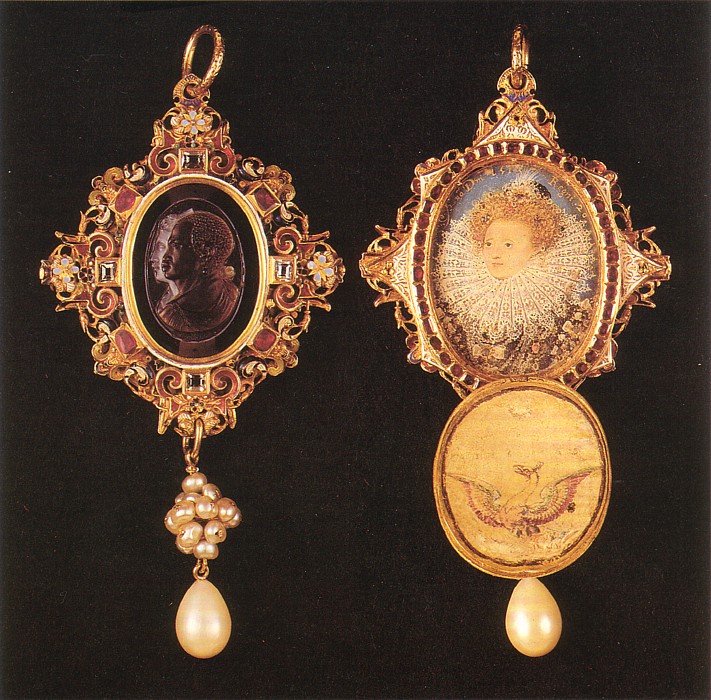
King Charles II Stuart licensed a British man to find a colony in Suriname.
He was called the Black Boy, and described in a wanted poster as A tall black man.
A striking black engraving after a now whitened painted portrait.
This is the Sack Dress or the Robe á lá Française our 18th century ancestors wore.
Its the most formal dress, for every day they
had more simple styles. This dress required a corset, and two joined wicker
baskets to widen the skirt. It was a skirt, a corset or bodice, covered in from
with a piece of fabric, with decorations, and next the over dress, with lace on
the sleeves. It was light and not hot. It gave the women an illusion of a
narrow waist, and the ladies of the French court took little steps, so it
looked as if they glided. Men wore an equally ornamented style of coat of silk,
a vest, a lace decorated linen shirt, and tight half breeches, and silk
stockings. Often high heeled shoes. The men were equally colorful as the women.
They wore a wig, which was powdered, and wore make-up.
1. 200 years a kingdom: portraits of the
brown and black complexioned, black Dutch royal house of Orange-Nassau
(1533-2013)
Codfried,
Egmond / Suriname Blue Blood is Black Blood Museum / 2013
2. Badal, or, The suicide of a reformed
housenigger (CAN BE READ ONLINE)
Codfried,
Egmond / Codfried / 2012
3. Was Jane Austen black?
Codfried,
Egmond / 1st ed / Codfried / 2011
4. Will there be another Holocaust? =
Komt er weer een Holocaust? (CAN BE READ ONLINE)
Codfried, Egmond / Codfried / 2010
5. Blue blood is
black blood : the iconographical proof of a dominating black and colored
European race who were a noble and royal elite (1500-1789) = Blauw bloed is
zwart bloed : het iconografisch bewijs van een dominerende zwarte en gekleurde
Europese natie die een adellijke en koninklijke elite was (1500-1789)
Codfried, Egmond / Codfried / [2009]
6. De vijand van de
Neeger
Codfried, Egmond / Codfried / 2006-...
7. De vijand van de
Neeger ; Dl. 1: Ongeediteerde correspondentie en columns 2004-2006
Codfried, Egmond
/ 1e dr / Codfried / 2006
8. Carmelita, Carmen!
Codfried, Egmond
/ 1e dr / Codfried / 2006
9. Maria Susanna Du Plessis (1739-1795) :
dader of slachtoffer?
Codfried, Egmond
/ 8e bew. dr / Codfried / 2005
10. Belle van Zuylen's vergeten oma:
Maria Jacoba van Goor (1687-1737) : een beknopte studie over zwarten en
kleurlingen in Europa en Nederland door de eeuwen heen
Codfried, Egmond
/ 1e verb. dr / Codfried / 2005
11. Belle van
Zuylen's vergeten oma: Maria Jacoba van Goor (1687-1737) : een beknopte studie
over zwarten en kleurlingen in Europa en Nederland door de eeuwen heen
Codfried,
Egmond / Codfried / 2004
12. Maria Susanna Du Plessis (1739-1795) :
dader of slachtoffer?
Codfried,
Egmond / 4e bew. dr / Egmond Codfried / cop. 2003
.jpg)


.jpg)